
Dr. Bhimrao Ramji Ambedkar – The Man Who Gave Voice to the Voiceless
Introduction
Some lives don’t just pass through history—they reshape it. Dr. Bhimrao Ramji Ambedkar was one such life. He did not inherit power, privilege, or popularity. What he carried instead was pain, intellect, and an unbreakable resolve. Born into a society that told him he was “less,” Ambedkar grew up to challenge that very idea with reason, law, and moral courage. His story is not merely a biography; it is a reminder of how one determined human being can bend the arc of history toward justice.
Birth and Early Life
Dr. Ambedkar was born on 14 April 1891 in Mhow, in present-day Madhya Pradesh, into a Mahar family—considered “untouchable” under the rigid caste hierarchy of colonial India. His father, Ramji Maloji Sakpal, served in the British Indian Army, which provided some stability but could not shield the family from social humiliation.
Social Environment of Colonial India
From an early age, Ambedkar experienced exclusion that would leave permanent marks on his mind. In school, he was made to sit separately. He could not drink water unless someone poured it from a height. These weren’t isolated incidents—they were daily reminders of where society believed he belonged.
Childhood Memories That Shaped His Mind
Ambedkar later wrote that these moments taught him not just suffering, but awareness. Even as a child, he began to question why dignity was denied by birth. That questioning never left him.
Educational Journey
Education became Ambedkar’s quiet rebellion. Despite hostility, he excelled academically. After completing his early studies in India, his brilliance earned him a scholarship from the Gaekwad of Baroda.
Studies in the United States
In 1913, Ambedkar traveled to Columbia University, New York. For the first time, he experienced a society where caste did not define his worth. He studied economics, sociology, and political science, earning a Master’s degree and later a PhD. The freedom of thought he encountered there deeply influenced his democratic ideals.
Academic Life in the United Kingdom
Ambedkar later studied at the London School of Economics and qualified as a barrister from Gray’s Inn. Financial hardships forced interruptions, but his determination never faded.
Scholarships and Financial Struggles
There were times when he survived on minimal food and lived in near isolation. Yet, he persisted, believing education was the sharpest weapon against oppression.
Social Discrimination and Personal Struggles
Returning to India did not bring relief. Ambedkar faced humiliation even as a highly educated man. In Baroda, he was denied housing and office space because of his caste. These experiences strengthened his resolve to fight systemic injustice, not through anger, but through reform.
Role as a Social Reformer
Ambedkar emerged as a powerful voice for the oppressed. He organized movements demanding basic human rights—access to water, education, and temples.
Mahad Satyagraha
In 1927, he led the Mahad Satyagraha, asserting the right of Dalits to draw water from public tanks. It was not just about water; it was about dignity.
Awakening a Silent Community
Through speeches, journals, and organizations, Ambedkar awakened political consciousness among those long silenced.
Role in the Indian Constitution
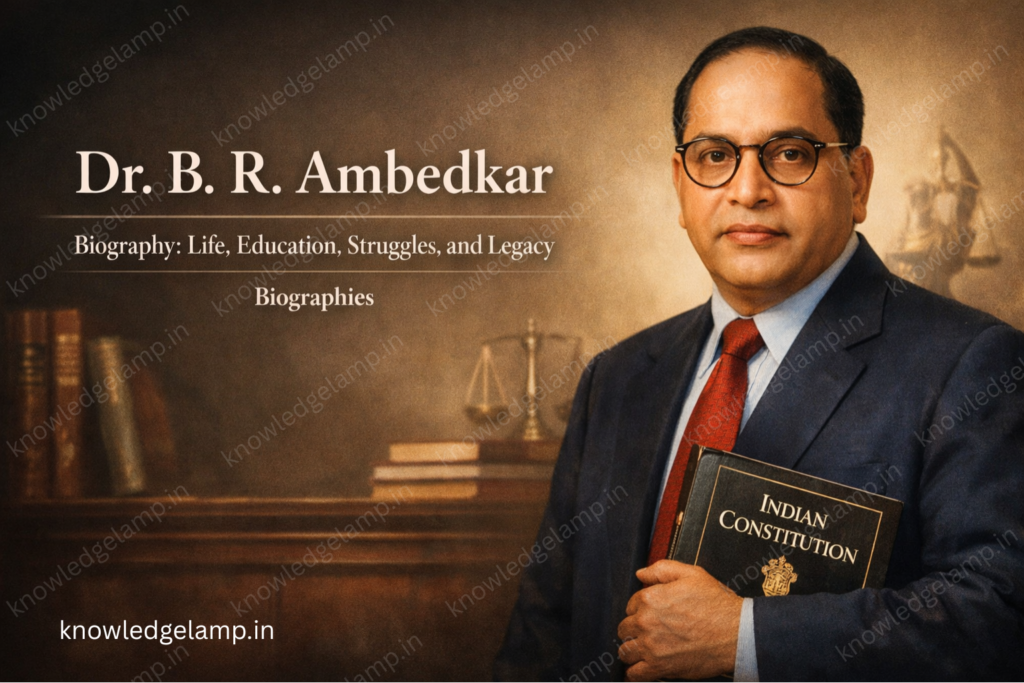
Perhaps Ambedkar’s greatest legacy lies in his role as the Chairman of the Drafting Committee of the Indian Constitution.
Philosophy Behind the Constitution
He envisioned India not merely as a political democracy, but a social one—where equality was lived, not just written.
Justice, Liberty, Equality, Fraternity
These four principles, inspired by the French Revolution, became the soul of the Constitution. Ambedkar ensured safeguards for minorities, Dalits, and women, knowing democracy without social justice is hollow.
Political Life
Ambedkar founded several political organizations, including the Independent Labour Party and later the Scheduled Castes Federation.
Labour Minister of Independent India
As India’s first Law and Labour Minister, he introduced progressive labor laws, advocated for women’s rights, and emphasized industrial justice. Yet, political resistance often limited his influence.
Important Books and Ideology
Ambedkar was also a prolific writer.
Annihilation of Caste
This work remains one of the most powerful critiques of caste ever written. It challenged not just social practices, but religious justifications for inequality.
Thoughts on Social Democracy
Ambedkar believed democracy must rest on moral foundations. Without equality and fraternity, he warned, political freedom would collapse.
Reason for Embracing Buddhism
In 1956, Ambedkar embraced Buddhism along with thousands of followers.
He saw Buddhism as a path rooted in compassion, reason, and equality—values absent in caste-based Hindu orthodoxy. His conversion was not rejection, but renewal.
Awards and Achievements
In 1990, decades after his death, Ambedkar was awarded the Bharat Ratna, India’s highest civilian honor. Universities, institutions, and movements worldwide continue to draw inspiration from his work.
Death and Legacy
Dr. Ambedkar passed away on 6 December 1956 in Delhi. His death marked the end of a life lived in struggle, but not the end of his influence. Today, his writings guide courts, classrooms, and conversations on justice.
Relevance of Dr. Ambedkar in Modern India
In an age of social media debates and constitutional challenges, Ambedkar’s ideas feel more relevant than ever. He reminds us that rights must be defended, equality must be practiced, and democracy must be nurtured daily.
Conclusion
Dr. B.R. Ambedkar was not just a leader of the oppressed; he was a thinker for all humanity. He taught us that true freedom is incomplete without dignity, and laws are meaningless without moral courage. Reading his life is not an academic exercise—it is a call to conscience.
Frequently Asked Questions (FAQs)
1. Why is Dr. Ambedkar called the architect of the Indian Constitution?
Because he played the central role in drafting it and shaping its core principles.
2. What was Ambedkar’s biggest contribution to Indian society?
His lifelong fight against caste discrimination and his vision of social democracy.
3. Why did Ambedkar convert to Buddhism?
He found in Buddhism a philosophy of equality, compassion, and rationality.
4. Which book by Ambedkar is most influential?
Annihilation of Caste is considered his most impactful work.
5. Why is Ambedkar still relevant today?
His ideas continue to guide discussions on equality, justice, and constitutional values.